
What is TikZ?
TikZ is a powerful LaTeX package for creating high-quality vector graphics programmatically within your documents.
TikZ: A Graphics Language for LaTeX
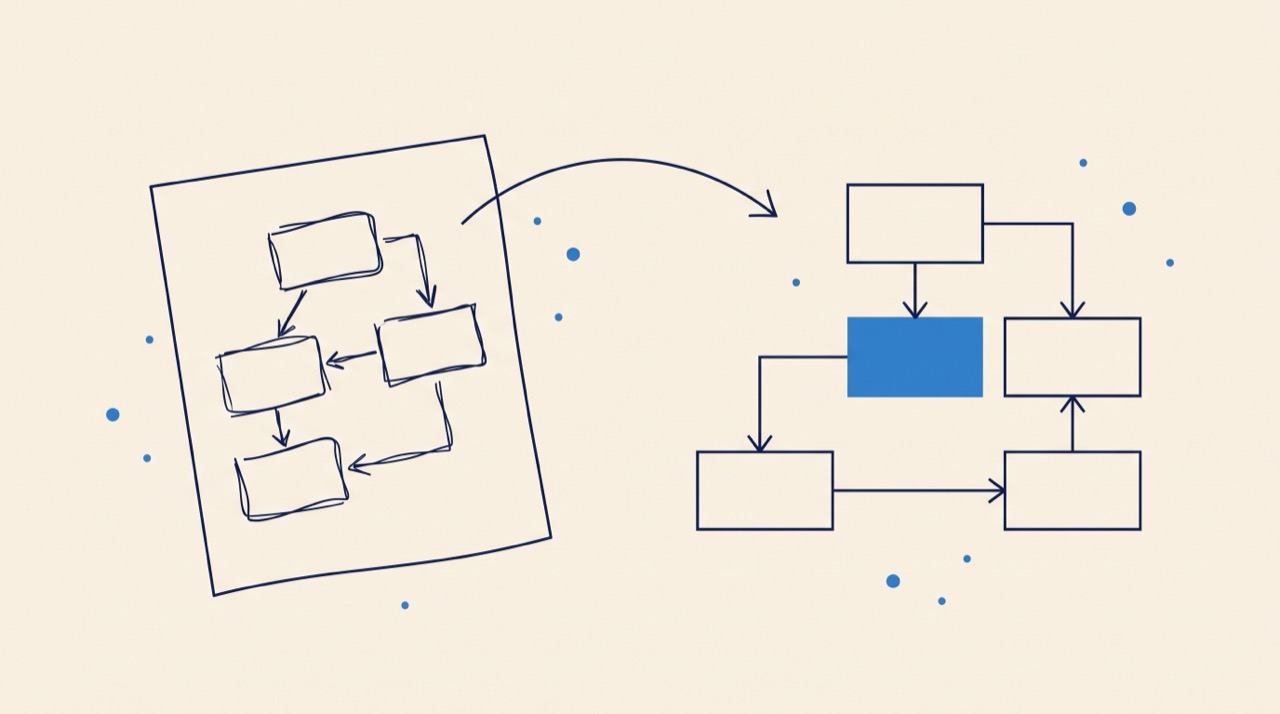
TikZ (which recursively stands for "TikZ ist kein Zeichenprogramm" - German for "TikZ is not a drawing program") is a LaTeX package that allows you to create sophisticated graphics using a descriptive language. Instead of drawing shapes manually, you describe what you want using code, and TikZ renders it perfectly.
TikZ is built on top of PGF (Portable Graphics Format), a lower-level graphics system. While PGF provides the foundation, TikZ offers a more user-friendly syntax that makes it easier to create complex graphics.
Why Use TikZ?
- Vector Graphics: TikZ produces scalable vector graphics that look crisp at any resolution, perfect for publication.
- LaTeX Integration: Use LaTeX math and text formatting directly in your graphics with consistent typography.
- Reproducibility: Graphics are defined by code, making them easy to version control and modify.
- Precision: Exact control over coordinates, dimensions, and positioning.
- Extensive Libraries: Pre-built libraries for flowcharts, circuits, graphs, trees, and more.
What Can You Create with TikZ?
TikZ is incredibly versatile. Common use cases include:
- Flowcharts and process diagrams
- Block diagrams and system architectures
- Graphs and network diagrams
- Tree structures and hierarchies
- Geometric figures and mathematical illustrations
- Circuit diagrams (with circuitikz library)
- Mind maps and concept maps
- Neural network diagrams
- State machines and automata
- Timelines and Gantt charts
Basic TikZ Example
Here's a simple example of TikZ code that draws a circle:
TikZ vs Other Graphics Options
While you can include external images in LaTeX, TikZ offers several advantages:
- vs External Images: TikZ graphics scale perfectly, match document fonts, and don't require separate files.
- vs PSTricks: TikZ works with both pdfLaTeX and XeLaTeX, while PSTricks requires special compilation.
- vs Asymptote: TikZ is easier to learn and integrates more seamlessly with LaTeX.
TikZ is included in most LaTeX distributions (TeX Live, MiKTeX) by default. In online editors, you can use TikZ immediately without any installation.
Getting Started
Ready to start creating graphics with TikZ? Continue with our TikZ for Beginners tutorial to learn the fundamentals, or jump to Basic Setup if you want to configure your document right away.
What is TikZ?
TikZ is a powerful LaTeX package for creating high-quality vector graphics programmatically within your documents.
TikZ: A Graphics Language for LaTeX
TikZ (which recursively stands for "TikZ ist kein Zeichenprogramm" - German for "TikZ is not a drawing program") is a LaTeX package that allows you to create sophisticated graphics using a descriptive language. Instead of drawing shapes manually, you describe what you want using code, and TikZ renders it perfectly.
TikZ is built on top of PGF (Portable Graphics Format), a lower-level graphics system. While PGF provides the foundation, TikZ offers a more user-friendly syntax that makes it easier to create complex graphics.
Why Use TikZ?
- Vector Graphics: TikZ produces scalable vector graphics that look crisp at any resolution, perfect for publication.
- LaTeX Integration: Use LaTeX math and text formatting directly in your graphics with consistent typography.
- Reproducibility: Graphics are defined by code, making them easy to version control and modify.
- Precision: Exact control over coordinates, dimensions, and positioning.
- Extensive Libraries: Pre-built libraries for flowcharts, circuits, graphs, trees, and more.
What Can You Create with TikZ?
TikZ is incredibly versatile. Common use cases include:
- Flowcharts and process diagrams
- Block diagrams and system architectures
- Graphs and network diagrams
- Tree structures and hierarchies
- Geometric figures and mathematical illustrations
- Circuit diagrams (with circuitikz library)
- Mind maps and concept maps
- Neural network diagrams
- State machines and automata
- Timelines and Gantt charts
Basic TikZ Example
Here's a simple example of TikZ code that draws a circle:
TikZ vs Other Graphics Options
While you can include external images in LaTeX, TikZ offers several advantages:
- vs External Images: TikZ graphics scale perfectly, match document fonts, and don't require separate files.
- vs PSTricks: TikZ works with both pdfLaTeX and XeLaTeX, while PSTricks requires special compilation.
- vs Asymptote: TikZ is easier to learn and integrates more seamlessly with LaTeX.
TikZ is included in most LaTeX distributions (TeX Live, MiKTeX) by default. In online editors, you can use TikZ immediately without any installation.
Getting Started
Ready to start creating graphics with TikZ? Continue with our TikZ for Beginners tutorial to learn the fundamentals, or jump to Basic Setup if you want to configure your document right away.