Sigma Symbol (Σ, σ): Summation, Standard Deviation and LaTeX
June 17, 2026
The sigma symbol is Σ in uppercase and σ in lowercase. Uppercase Σ means “add all of these up”. Lowercase σ almost always means standard deviation in statistics, or stress in engineering. Copy either below, or jump to how to type it.
Copy and paste the sigma symbols
| Character | Unicode | HTML entity | LaTeX | Windows alt code |
|---|---|---|---|---|
| Σ uppercase sigma | U+03A3 | Σ | \Sigma | Alt + 228 |
| σ lowercase sigma | U+03C3 | σ | \sigma | Alt + 229 |
Copy and paste: click either card above to copy the character to your clipboard — Σ for summation and uppercase use, σ for standard deviation. Both paste cleanly into Word, Google Docs, Slack and any modern editor.
Greek has a third form: ς (U+03C2, \varsigma), the final sigma, used when the letter ends a word in Greek text. It has no mathematical meaning.
Σ is not the same character as ∑
This trips up more people than anything else about sigma. There are two visually similar characters and they are not interchangeable:
| Character | Unicode | Name | Use |
|---|---|---|---|
| Σ | U+03A3 | Greek capital sigma | The letter — in text, names, variables |
| ∑ | U+2211 | N-ary summation | The operator — in formulas |
The summation operator is taller and gets extra spacing from limits above and below. Word’s equation editor and LaTeX both insert the correct one automatically, so you rarely need to pick by hand — but if you paste a formula out of a PDF, check which one you got.
Σ as summation
The index below the sigma says where to start, the value above says where to stop, and the expression to the right is what gets added:
An arithmetic series has a closed form worth memorising:
Sums nest, and the index can run over a set rather than a range:
σ as standard deviation
Lowercase sigma is the population standard deviation — the square root of the variance, and a measure of how far values sit from the mean:
It also sets the width of the normal distribution, which is where the 68–95–99.7 rule comes from:
σ is the population standard deviation; s is the sample estimate, which divides by N − 1. Using σ when you only have a sample understates the spread.
Other meanings of σ
- Mechanics — stress, force per unit area:
σ = F/A - Electromagnetism — electrical conductivity, or surface charge density
- Thermodynamics — the Stefan–Boltzmann constant
- Chemistry — a sigma bond, the head-on overlap of two orbitals
- Manufacturing — Six Sigma, meaning six standard deviations between the mean and the nearest specification limit
How to type the sigma symbol
Windows
- Uppercase Σ:
Alt + 228on the numeric keypad - Lowercase σ:
Alt + 229 - In Word, type
03C3thenAlt + Xfor σ, or2211thenAlt + Xfor the ∑ operator
Mac
Option + Wgives ∑, the summation operator — not the Greek letter- For the letter, open Character Viewer with
Control + Command + Spaceand search “sigma”
HTML
Σfor Σ,σfor σ∑for the ∑ operator
The sigma symbol in LaTeX
LaTeX keeps the letter and the operator strictly separate, which is the main thing to learn here. \Sigma is the letter; \sum is the operator that takes limits:
In a displayed equation the limits sit above and below automatically. Inline, they move beside the symbol to keep line spacing even — force the displayed style with \limits if you need it:
Frequently asked questions
What does Σ mean in maths?
Add everything up. The index below gives the starting value, the number above the stopping value, and the expression to the right is the term being summed.
What does σ mean in statistics?
The population standard deviation — the square root of the variance. A larger σ means the data is more spread out around the mean.
Why are there two lowercase sigmas?
Greek writes σ inside a word and ς at the end of one. Mathematics only ever uses σ.
See also our guide to integrals and summations in LaTeX, the omega symbol and the alpha symbol.
Try it free
Hours of retyping, gone.
Drop in a page of formulas from your notes or a reference paper and get compiling LaTeX back in seconds — limits, indices and Greek letters already in the right places. A morning’s transcription becomes one upload.
Convert your paper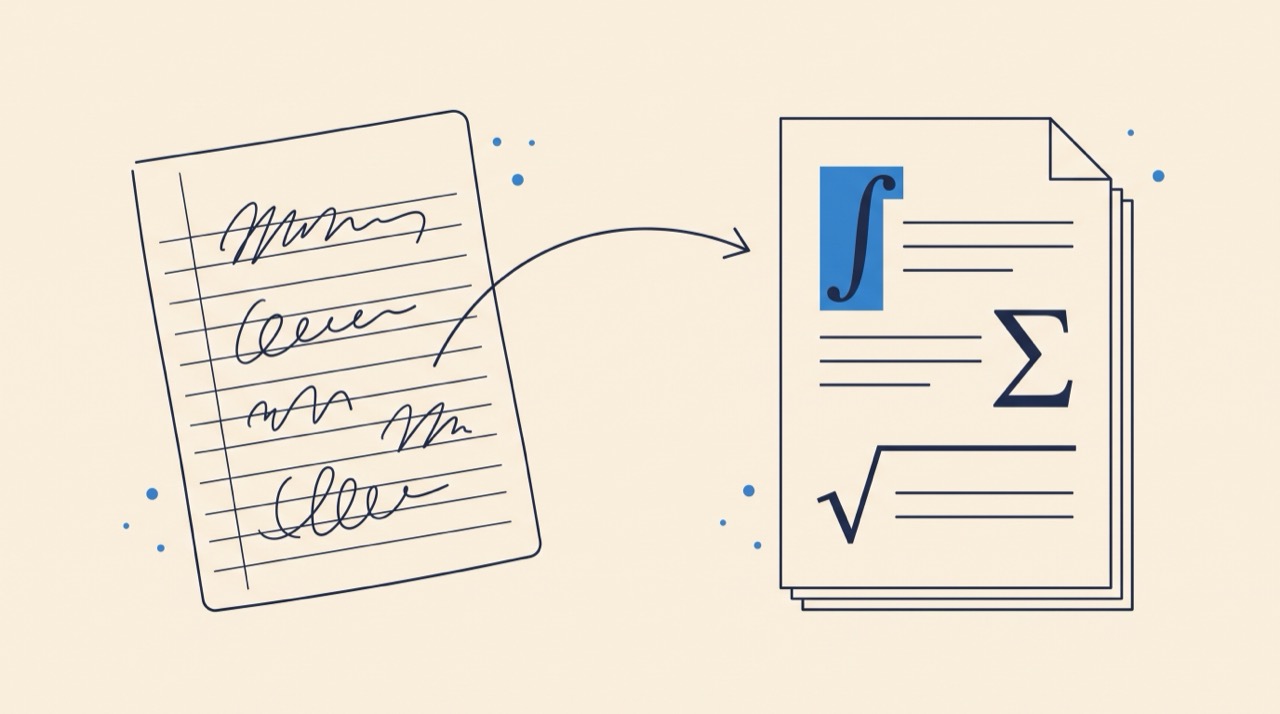

Practical tools for academic writing, document conversion, and research workflows.
Go to appContact usAsk AI about Underleaf
© 2026 Underleaf. All rights reserved.