Square Root Symbol (√): Meaning, How to Type It, and LaTeX
June 5, 2026
The square root symbol is √, called the radical sign. It asks for the number that multiplies by itself to give what sits under it. Copy it below, or jump to how to type it — including the cube root ∛ and the fourth root ∜.
Copy and paste the square root symbol
Select a character to copy it, or use the Unicode, HTML, Alt-code, or LaTeX value in the reference table.
| Character | Unicode | HTML entity | LaTeX | Windows alt code |
|---|---|---|---|---|
| √ square root | U+221A | √ | \sqrt{x} | Alt + 251 |
| ∛ cube root | U+221B | ∛ | \sqrt[3]{x} | — |
What the radical sign means
| Where | Meaning |
|---|---|
| Arithmetic | √9 = 3 — the non-negative number whose square is 9 |
| Algebra | Appears in the quadratic formula, under the discriminant |
| Geometry | Pythagoras and the distance formula |
| Statistics | Standard deviation is the root of the variance |
| Notation | The bar over the expression is the vinculum — it groups |
The principal square root
Every positive number has two square roots, one positive and one negative. The radical sign means specifically the non-negative one, which is why the quadratic formula has to write ± explicitly — the symbol alone would only give you half the answer.
The bar matters: √ is not the same as \sqrt
This is the detail that makes typed maths look wrong. The character √ is just a hook — it has no horizontal bar, so it cannot show where the expression ends. Typing √b² − 4ac is ambiguous: does the root cover the whole thing or just the b²? The vinculum is what resolves it, and only a real typesetter draws one that stretches.
If you only need the bare character in running text, √ is fine. If it sits over an expression, use a real formula — otherwise the reader has to guess the grouping.
Higher roots and fractional powers
The small number in the notch is the index. A square root has an implied index of 2, which is why it is left off. Every root is also just a fractional power, which is usually easier to manipulate algebraically.
Where it shows up
Pythagoras and the distance formula are the same statement, and the standard deviation is a root because the variance is measured in squared units — taking the root puts it back into the units of the data.
How to type it
Windows
- √: hold
Altand type251on the numeric keypad - In Word, type
221Aand pressAlt + X; use221Bfor ∛ and221Cfor ∜ - For a root with a proper bar, use Word’s equation editor (
Alt + =) rather than the bare character
Mac
- √:
Option + V - For ∛ and ∜, open Character Viewer with
Control + Command + Spaceand search “root”
HTML
√or√for √∛for ∛,∜for ∜- For a bar that stretches, use MathML or a maths renderer — plain HTML has no vinculum
In LaTeX
\sqrt draws the sign and the vinculum together, sized to whatever you put in the braces. The optional argument in square brackets sets the index for higher roots.
Braces are what set the scope. \sqrt x + 1 roots only the x; \sqrt{x + 1} roots the sum. Leaving them off is the most common square-root bug in student work.
Frequently asked questions
How do I type the square root symbol?
Alt + 251 on Windows with a numeric keypad, Option + V on Mac, or copy √ from the card above.
Why does my square root have no bar over it?
Because the √ character is only a hook. The horizontal bar is drawn by a maths typesetter, not stored in the character, so you need an equation editor or LaTeX to get one that stretches over the expression.
What is the symbol with a small 3 in it?
The cube root, ∛ (U+221B). The small number is the index; a square root has an implied index of 2, so it is left off.
See also the plus-minus symbol that appears alongside it in the quadratic formula, the sigma symbol, and fractions in LaTeX.
Try it free
Hours of retyping, gone.
Drop in a page of working and get compiling LaTeX back in seconds — roots, fractions and limits already grouped correctly. A morning’s transcription becomes one upload.
Convert your paper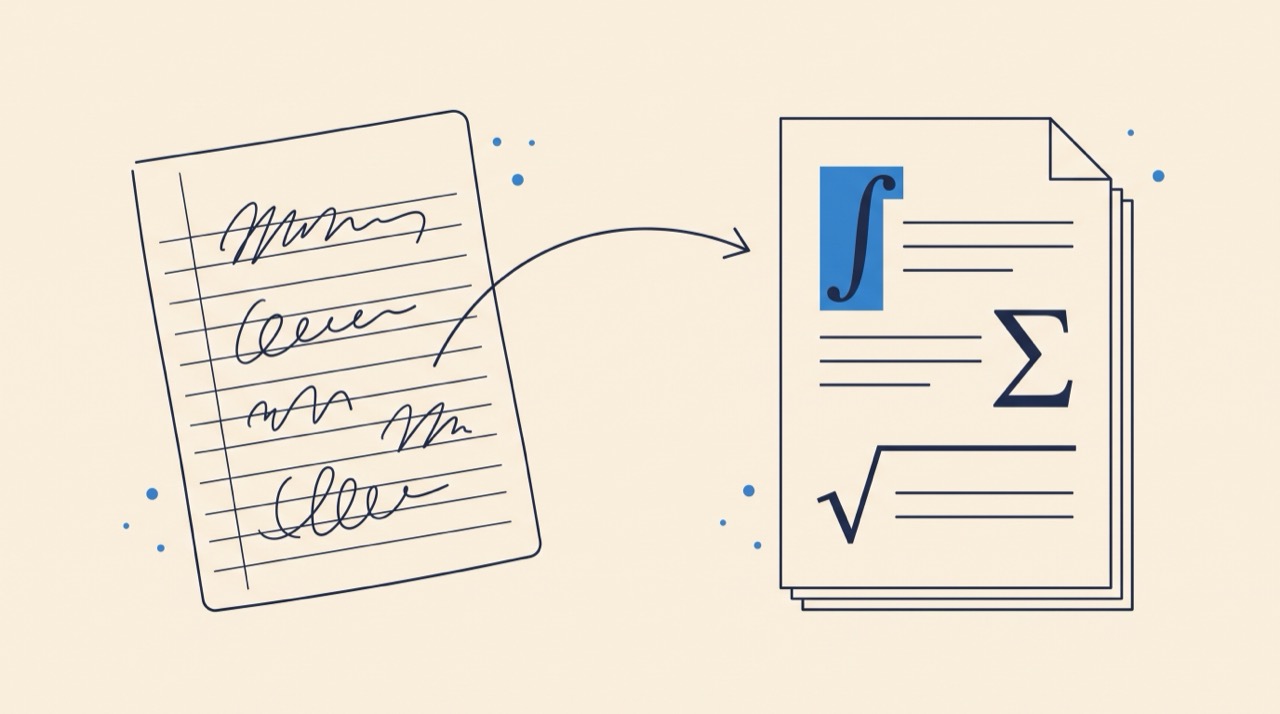

Practical tools for academic writing, document conversion, and research workflows.
Go to appContact usAsk AI about Underleaf
© 2026 Underleaf. All rights reserved.