Underleaf Logo
Underleaf
UniversitiesAccessibilityBlogPricing
Log InTry Free
All tools

Teaching & Faculty

Teaching & Faculty

Problem Set Generator (LaTeX)

A clean LaTeX problem-set template with problem and solution environments, built for math, physics, and CS courses.

Input

Problem set details

Live LaTeX preview as you edit

Math notation uses $...$, toggle solutions off to produce the student-facing copy.

Output

Problem set LaTeX

Toggle solutions before compiling for student/instructor versions

\documentclass[11pt]{article} \usepackage[margin=1in]{geometry} \usepackage{amsmath, amssymb, amsthm} \usepackage{enumitem} \usepackage{xcolor} \usepackage{hyperref} \newcounter{problemnum} \newenvironment{problem}[1]{% \refstepcounter{problemnum}% \noindent\textbf{Problem #1.}\quad }{\vspace{1em}} \newenvironment{solution}{% \noindent\textit{\color{teal!70!black}Solution.}\quad }{\vspace{1em}} \title{Introduction to Real Analysis \ -- \ Problem Set 3} \author{MATH 131A} \date{Due: October 15, 2026} \begin{document} \maketitle \noindent\textbf{Topic:} Sequences, limits, and continuity \bigskip \begin{problem}{1} Prove that the sequence $a_n = (1 + 1/n)^n$ is monotonically increasing and bounded above by 3. Conclude that $a_n$ converges. \end{problem} \begin{solution} We show $a_n < a_{n+1}$ by applying the binomial theorem to both sides and comparing term by term. The bound follows from the geometric series estimate $\sum_{k=0}^n \frac{1}{k!} \le 1 + \sum_{k=1}^n \frac{1}{2^{k-1}} < 3$. \end{solution} \begin{problem}{2} Let $f: [a, b] \to \mathbb{R}$ be continuous. Prove that $f$ attains its maximum on $[a, b]$. \end{problem} \begin{solution} By boundedness of continuous functions on compact intervals, $M = \sup f$ exists and is finite. Take a sequence $x_n$ with $f(x_n) \to M$; by Bolzano-Weierstrass, $x_n$ has a convergent subsequence $x_{n_k} \to x^* \in [a, b]$. By continuity, $f(x^*) = M$. \end{solution} \begin{problem}{3} Suppose $f_n \to f$ pointwise on $[0, 1]$ and each $f_n$ is continuous. Give an example where $f$ is not continuous. \end{problem} \begin{solution} Take $f_n(x) = x^n$. Then $f_n \to f$ pointwise where $f(x) = 0$ for $x < 1$ and $f(1) = 1$, which is discontinuous at $x = 1$. \end{solution} \end{document}

Write problem sets in Underleaf

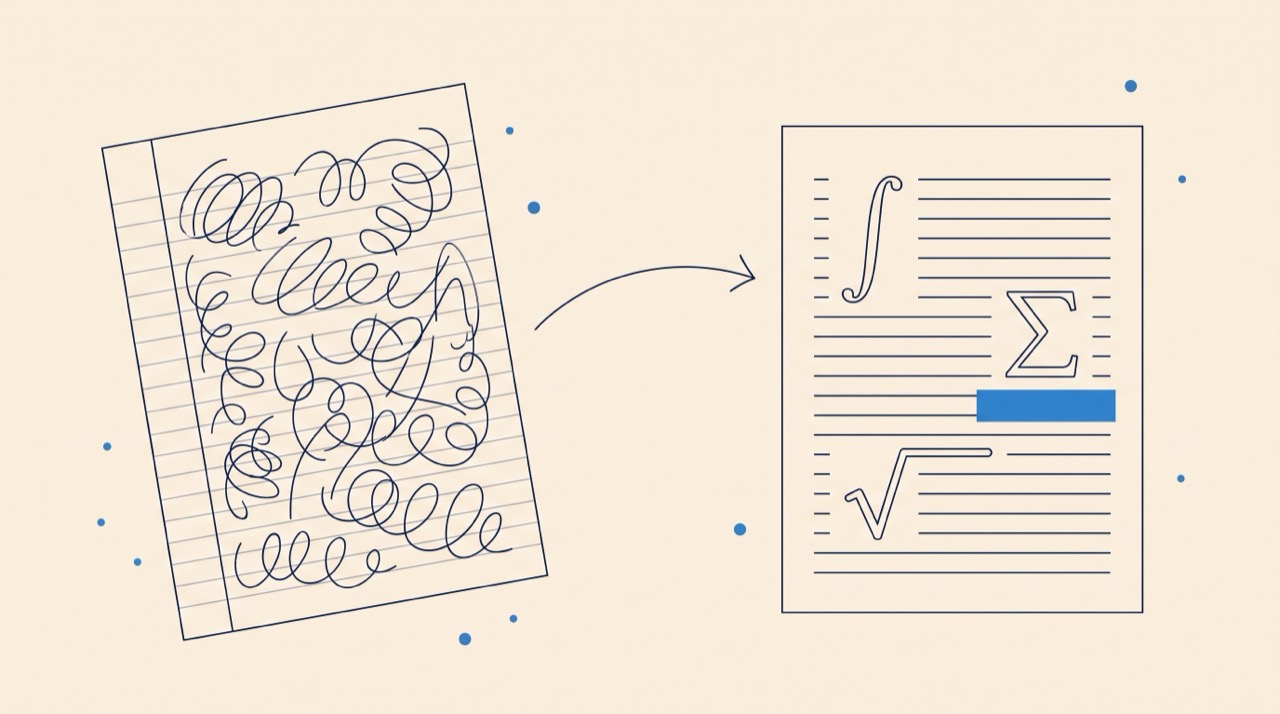
Underleaf is an AI LaTeX editor with inline writing help, image-to-LaTeX (handy for retyping board work), and a citation finder. Or use the Chrome extension inside Overleaf.

Try Underleaf free

Two versions, one source file

Every TA workflow has the same pain: write problems + solutions once, then maintain a second "student version" with the solutions blanked out. The toggle on this tool does that mechanically, keep your solutions next to the problems in the source, flip the switch to publish the student copy. No more accidentally posting the answer key.

The template uses standard math packages (amsmath, amssymb, amsthm) and defines a problem / solution environment pair. If you teach with a textbook that uses a specific theorem style, you can keep that, just paste your custom \newtheorem commands into the preamble.
Related tools

Syllabus generatorLecture notes → LaTeXLaTeX math symbols

Explore More Tools

Image to LaTeX

Convert images of notes, equations, or tables to LaTeX code.

Equation to LaTeX

Convert equations to LaTeX code from text or images.

Table to LaTeX

Convert tables to LaTeX code from text or images.

Excel to LaTeX

Convert Excel spreadsheet data to LaTeX tables.

Try more tools for free

Create an account to unlock all features

More file conversions

AI writing tools

PDF preview

100% free to try

Get started for free
Underleaf Logo
Underleaf

Empowering students and researchers with AI-powered tools for academic writing.

Go to appContact us

Company

PricingBlogTutorialsAffiliate Program

Free Tools

Image to LaTeXExcel to LaTeXArXiv to LaTeXTikZ GeneratorThesis GeneratorChrome ExtensionAll Tools

© 2026 Underleaf. All rights reserved.