Delta Symbol (Δ, δ): Meaning in Maths, Physics and LaTeX
June 3, 2026
The delta symbol is Δ in uppercase and δ in lowercase. Uppercase Δ means “change in” — a finite difference between two values. Lowercase δ means an infinitesimally small change, or one of several specific functions. Copy either below, or jump to how to type it.
Copy and paste the uppercase delta symbol
Select a character to copy it, or use the Unicode, HTML, Alt-code, or LaTeX value in the reference table.
| Character | Unicode | HTML entity | LaTeX | Windows alt code |
|---|---|---|---|---|
| Δ uppercase delta | U+0394 | Δ | \Delta | — |
| δ lowercase delta | U+03B4 | δ | \delta | Alt + 235 |
What the symbol means
| Where | Meaning |
|---|---|
| Maths | Change or difference between two values: Δx = x₂ − x₁ |
| Algebra | The discriminant of a quadratic, b² − 4ac |
| Calculus | δ is a vanishingly small change, the step before dx |
| Linear algebra | Kronecker delta δᵢⱼ — 1 when i = j, otherwise 0 |
| Signal processing | Dirac delta δ(x) — an impulse of unit area at zero |
| Chemistry | ΔH, ΔG, ΔS — change in enthalpy, free energy, entropy |
| Finance | Delta — sensitivity of an option price to the underlying |
Δ as change
This is the meaning you meet first. Uppercase delta in front of a quantity means the difference between its final and initial value, and it is always final minus initial — so a falling temperature gives a negative ΔT.
Δ, δ, ∂ and ∇ are four different things
These get mixed up constantly, and using the wrong one changes the meaning of an equation. Δ is a finite, measurable difference. δ is an infinitesimal one. ∂ is a partial derivative, used when a function has more than one variable. ∇ is the gradient operator, which turns a scalar field into a vector.
A common slip is writing ∆ (the increment sign, U+2206) instead of the Greek capital delta U+0394. They look identical in most fonts, but search, spell-check and screen readers treat them differently — prefer the Greek letter.
δ as the Kronecker and Dirac deltas
Two specific functions share the lowercase letter. The Kronecker delta is a discrete switch used all over linear algebra — it is simply the identity matrix written in index notation. The Dirac delta is a distribution: zero everywhere except the origin, with total area one.
Δ as the discriminant
For a quadratic, the sign of the discriminant tells you how many real roots there are before you solve anything: positive gives two, zero gives one repeated root, negative gives none.
How to type it
Windows
- Lowercase δ: hold
Altand type235on the numeric keypad - Uppercase Δ has no legacy alt code. In Word, type
0394and pressAlt + X - Anywhere else, press
Windows + .and search “delta”
Mac
- Uppercase Δ:
Option + J - For δ, open Character Viewer with
Control + Command + Spaceand search “delta”
HTML
ΔorΔfor Δδorδfor δ
In LaTeX
Both cases are single commands and both need math mode. Uppercase Greek is upright by default; \varDelta gives the italic form if you want it to match the lowercase letters.
\Delta is the letter, not an operator, so it takes no automatic spacing. Write \Delta x rather than \Delta \, x — LaTeX already sets it correctly.
Frequently asked questions
What does Δ mean in maths?
Change in, or difference between. Δx is the final value of x minus the initial value, so it can be negative.
What is the difference between Δ and δ?
Δ is a finite, measurable change you could put a number on. δ is an infinitesimal change — the conceptual step towards dx in calculus.
Is δ the same as ∂?
No. ∂ (U+2202, \partial) is specifically the partial derivative symbol, used when a function depends on several variables. δ is a Greek letter.
See also the omega symbol, sigma symbol and theta symbol, or our guide to Greek letters in LaTeX.
Try it free
Save hours on your next paper.
Turn lecture notes and handwritten derivations into submission-ready LaTeX in seconds. Every Greek letter and operator lands in place, so the hours go into the writing instead of the notation.
Convert your paper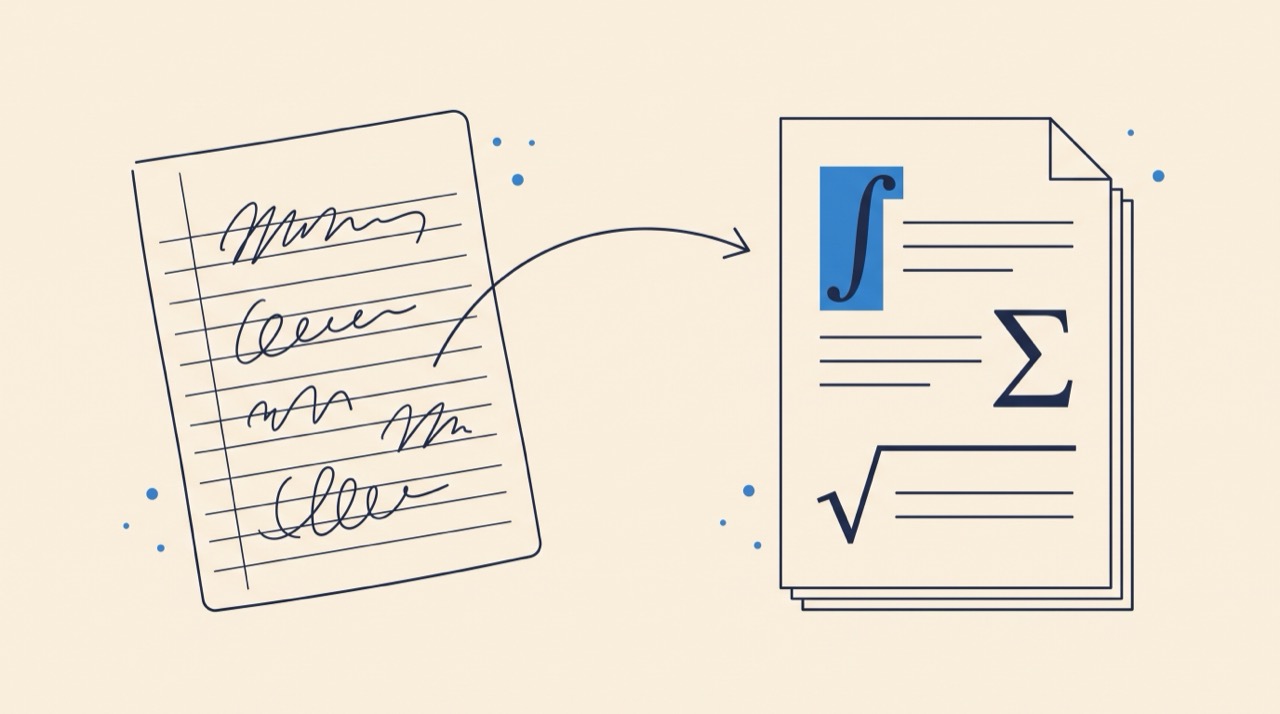

Practical tools for academic writing, document conversion, and research workflows.
Go to appContact usAsk AI about Underleaf
© 2026 Underleaf. All rights reserved.