
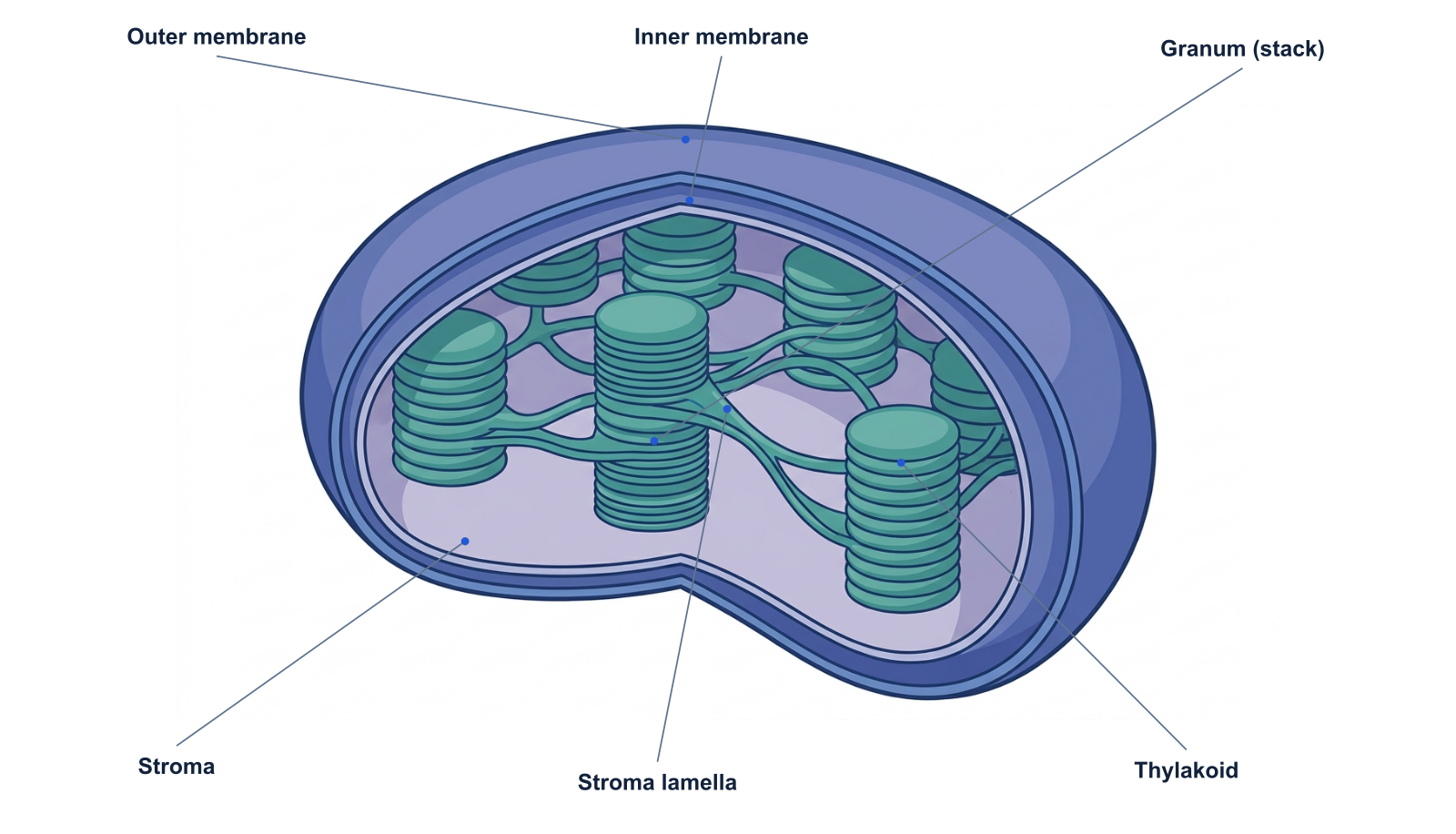
Simplified AI-generated chloroplast illustration with labels added separately. Membrane spacing and stack sizes are schematic.
A chloroplast organizes photosynthesis into connected compartments. Its envelope encloses the stroma, while an internal thylakoid membrane system provides surfaces for the light-dependent reactions.
The cutaway is useful because it separates three ideas that are often confused: a thylakoid is an individual membrane compartment, a granum is a stack of thylakoids, and the stroma is the fluid region around them.
Parts and functions
| Structure | What it does |
|---|---|
| Outer membrane | The outer boundary of the chloroplast envelope. |
| Inner membrane | The inner boundary of the envelope, enclosing the stroma. |
| Stroma | The fluid compartment containing enzymes involved in the Calvin cycle. |
| Thylakoid | A membrane-bound internal compartment; its membrane hosts the light-dependent reactions. |
| Granum (plural: grana) | A stack of thylakoids. |
| Stroma lamella | A membrane connection between regions of the thylakoid system. |
Connect structure with the two major stages
The light-dependent reactions take place in the thylakoid membrane. The Calvin cycle takes place in the stroma and uses products of those light reactions to support carbon fixation.
A labeled anatomy diagram and a process diagram answer different questions. Use this cutaway to explain where the stages happen. Use a separate photosynthesis overview to explain what enters, what leaves and how energy is transferred.
Thylakoid, granum and stroma: three different labels
Point to one flattened membrane compartment when introducing a thylakoid. Point to a stack when introducing a granum. Point to the fluid space outside the stacks when introducing the stroma.
The inside of a thylakoid is its lumen. The stroma and lumen are separated by the thylakoid membrane; they are not two names for the same region. This simplified figure does not enlarge the lumen as a separate labeled inset.
Use the cutaway in a teaching sequence
Start with the whole plant cell, enlarge one chloroplast, then switch to a process schematic. This sequence gives students a sense of scale without implying that the illustration itself has measured dimensions.
In Figure Maker, keep the envelope and stacks stable while adjusting label density. For a short revision slide, the three labels stroma, thylakoid and granum may be enough.
A prompt to start from
Frequently asked questions
References and further reading
Illustrations are explanatory models. Colors, proportions and selected structures are simplified to support the topic.
Keep exploring
Try it free
Start with a figure. Make it yours.
Open a starter, adapt the labels, and create an illustration for your next lecture or research discussion.
Starter examples are free to open. AI generation and edits use credits.