
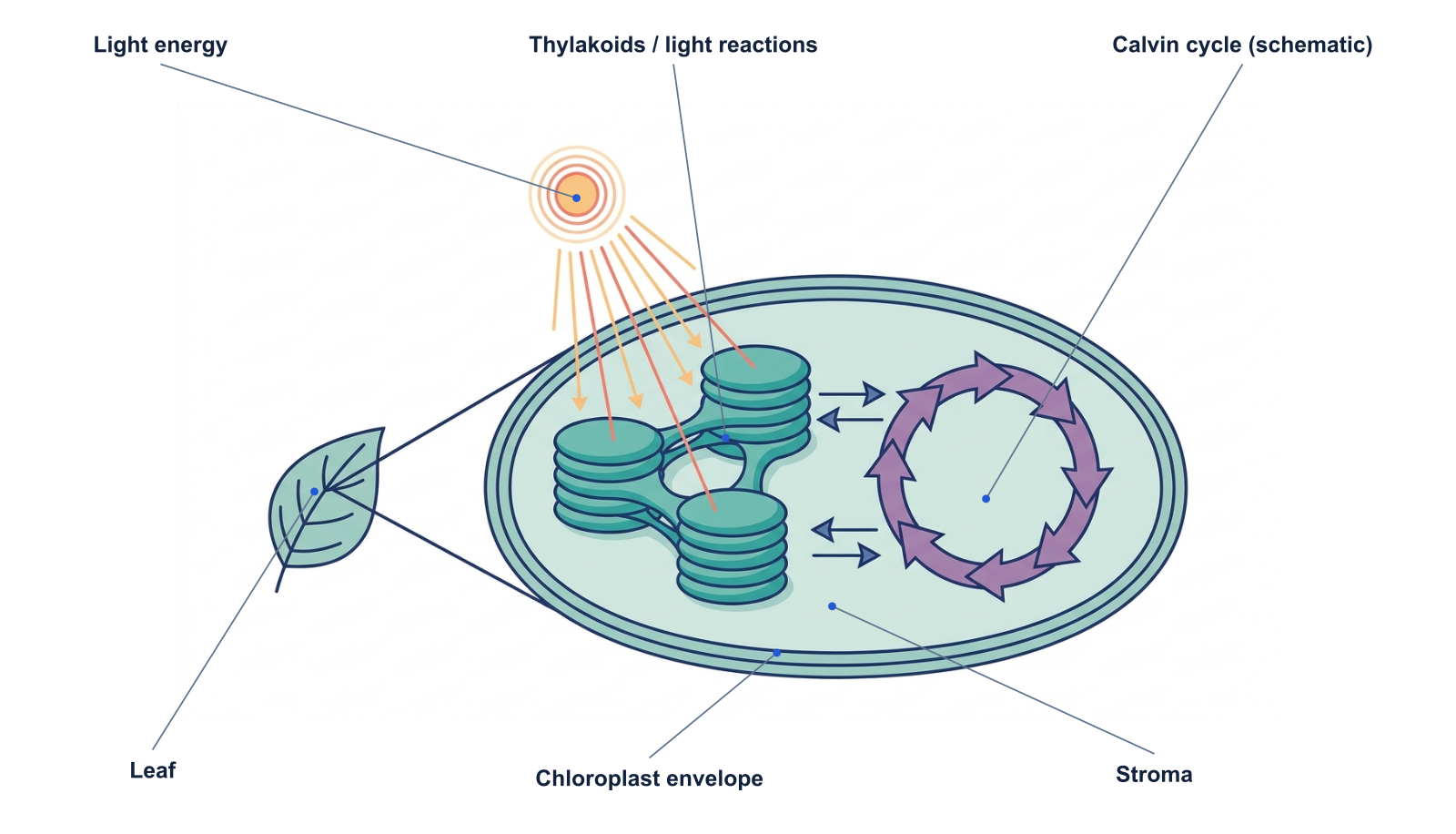
AI-generated concept illustration. Arrows between stages represent exchange at an overview level, not a complete biochemical pathway or a measurement of rates.
Photosynthesis captures light energy and uses it to support the formation of organic molecules from carbon dioxide. In plants, the chloroplast places the major stages in connected but distinct compartments.
Use this overview to establish where the stages occur. A detailed pathway figure would need additional molecules, enzymes and reaction steps; this image is designed to introduce the relationship first.
Parts and functions
| Structure | What it does |
|---|---|
| Light energy | Provides energy absorbed by photosynthetic pigments. |
| Thylakoids | Their membranes host the light-dependent reactions. |
| Stroma | The chloroplast fluid compartment in which the Calvin cycle occurs. |
| Calvin cycle | Uses ATP and NADPH to support carbon fixation and the production of carbohydrate precursors. |
| Chloroplast envelope | The surrounding double-membrane boundary. |
| Leaf | The organ context for many photosynthetic plant cells. |
Inputs and outputs at the whole-process level
A familiar net summary uses carbon dioxide, water and light to describe the production of carbohydrate and oxygen. This summary compresses many reactions and should not be read as a one-step mechanism.
Oxygen released by oxygenic photosynthesis comes from water. The carbon incorporated into organic molecules comes from carbon dioxide. Keep those origins distinct when adding arrows to an explanatory figure.
Two stages with different jobs
The light-dependent reactions generate ATP and NADPH and release oxygen from the splitting of water. The Calvin cycle uses ATP and NADPH in reactions that incorporate carbon dioxide and produce a three-carbon sugar phosphate.
Calling the Calvin cycle “light-independent” does not mean it normally runs only in darkness. Its activity is linked to the products and regulation of the light reactions.
- Place light-dependent reactions at the thylakoid membrane.
- Place the Calvin cycle in the stroma.
- Distinguish the energy carriers linking the stages from carbon entering the cycle.
Build a three-step explanation
First show the plant cell and locate a chloroplast. Next enlarge the chloroplast to identify thylakoids and stroma. Finally introduce the process diagram with inputs, outputs and carrier exchange.
For a slide aimed at beginners, keep the detailed enzyme names in your spoken explanation or a later panel. For an advanced class, construct a separate pathway with explicitly checked substrates and directions.
A prompt to start from
Frequently asked questions
References and further reading
Illustrations are explanatory models. Colors, proportions and selected structures are simplified to support the topic.
Keep exploring
Try it free
Start with a figure. Make it yours.
Open a starter, adapt the labels, and create an illustration for your next lecture or research discussion.
Starter examples are free to open. AI generation and edits use credits.