
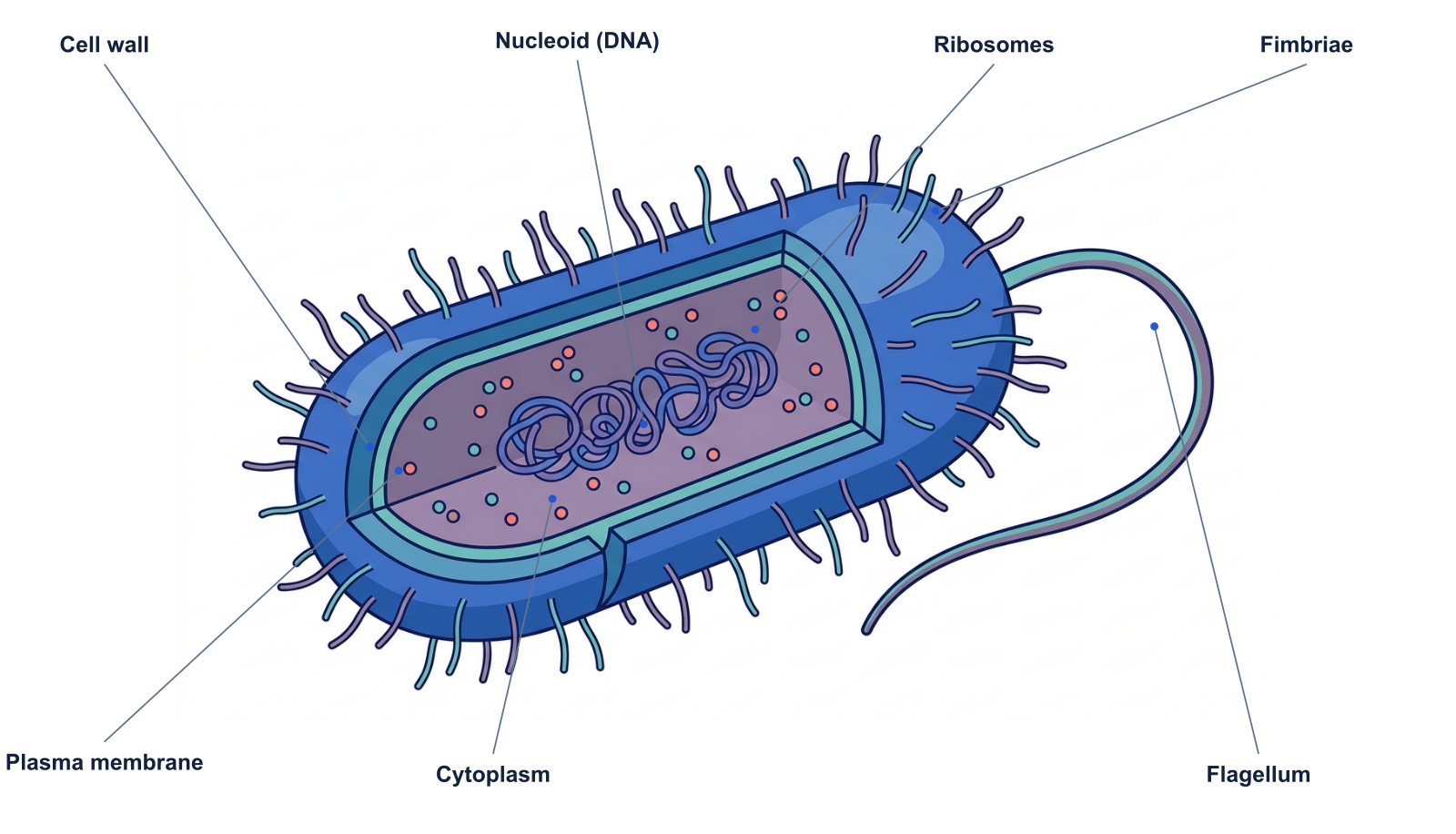
A generalized bacterial model, generated with AI and annotated separately. Bacteria and archaea vary; this combination of external structures is not present in every prokaryote.
Prokaryotes include bacteria and archaea. Their cells do not have a membrane-bound nucleus. In this generalized bacterial example, the main DNA-containing region is labeled nucleoid.
The drawing combines common teaching features in one cutaway. Use it to introduce the organization of a bacterial cell, then discuss the variations relevant to the organism you are studying.
Parts and functions
| Structure | What it does |
|---|---|
| Cell wall | A supporting layer outside the plasma membrane in many bacteria; its composition differs from a plant cell wall. |
| Plasma membrane | The selective boundary of the cytoplasm and a site of important cellular processes. |
| Cytoplasm | The internal environment containing enzymes, ribosomes and other cellular material. |
| Nucleoid | The DNA-containing region, not enclosed by a nuclear membrane. |
| Ribosomes | The cellular machinery for protein synthesis. |
| Fimbriae | Short surface appendages commonly involved in attachment. |
| Flagellum | A motility structure in many, but not all, bacteria. |
A nucleoid is not a small nucleus
The difference is the surrounding membrane. A eukaryotic nucleus is enclosed by a nuclear envelope, while the prokaryotic nucleoid is a region within the cell without that enclosing membrane.
The DNA is drawn as a visible thread to make the concept readable. That line should not be interpreted as an exact chromosome map, and the model does not imply that all bacteria have identical genome organization.
Which structures are optional?
A diagram can accidentally imply that every bacterium has a capsule, flagellum, plasmid and every type of appendage. That is not the case. This example labels only the structures selected for the visible model.
If you adapt it to a named organism, check whether the cell envelope and external appendages match that organism. A generic bacterial illustration is not automatically appropriate for an archaeon.
Compare prokaryotic and eukaryotic cells
Both need a boundary, genetic information, ribosomes and a cellular environment in which chemical reactions occur. The presence of a membrane-bound nucleus and many membrane-bound organelles distinguishes the usual eukaryotic model.
For a comparison worksheet, ask learners to identify shared functions before listing structural differences. This avoids the misleading impression that a cell without a nucleus has no DNA or cannot make proteins.
A prompt to start from
Frequently asked questions
References and further reading
Illustrations are explanatory models. Colors, proportions and selected structures are simplified to support the topic.
Keep exploring
Try it free
Start with a figure. Make it yours.
Open a starter, adapt the labels, and create an illustration for your next lecture or research discussion.
Starter examples are free to open. AI generation and edits use credits.