
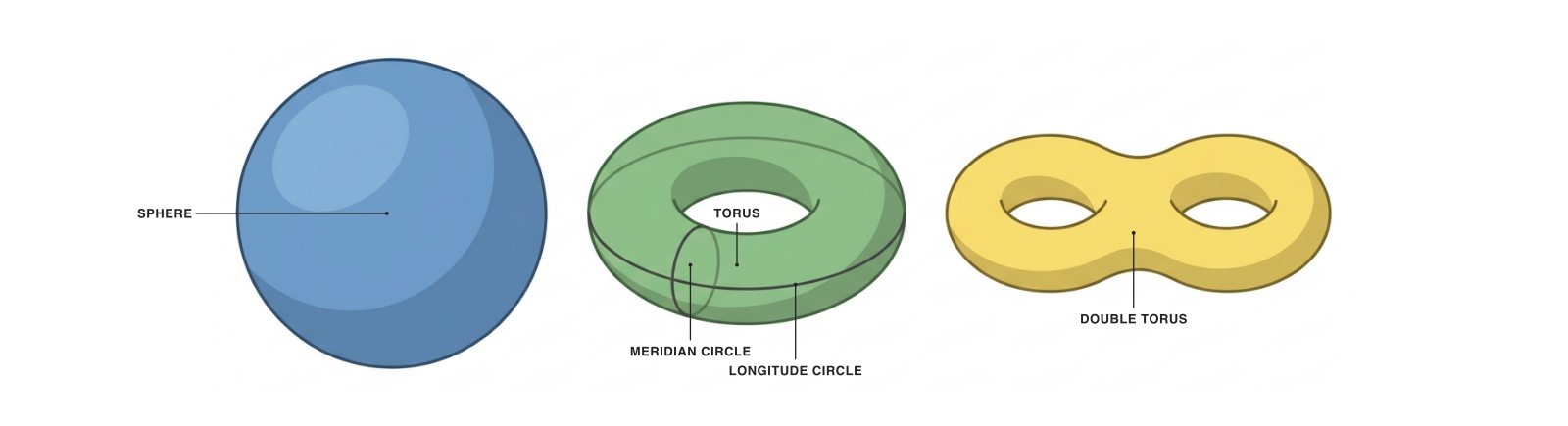
An explanatory surface illustration from Figure Maker. The drawing communicates topology and selected curves, rather than a measured geometric model.
A sphere, a torus and a double torus are useful examples of closed orientable surfaces. They make the idea of genus visible: zero handles for the sphere, one for the torus and two for the double torus.
The image also marks two familiar curves on a torus. Use it to introduce the vocabulary, then state the precise mathematical object and assumptions in the accompanying text.
Parts and functions
| Structure | What it does |
|---|---|
| Sphere | A closed orientable surface of genus 0. |
| Torus | A closed orientable surface of genus 1. |
| Double torus | A closed orientable surface of genus 2. |
| Meridian circle | A loop around the tube of the torus in this standard embedded picture. |
| Longitude circle | A loop running around the central opening in this standard embedded picture. |
Genus counts handles for this class of surfaces
For a connected closed orientable surface, the genus g is related to the Euler characteristic by χ = 2 − 2g. The sphere, torus and double torus therefore have Euler characteristics 2, 0 and −2.
The assumptions matter. The same formula should not be applied without modification to a surface with boundary or to a non-orientable surface. State the class of surfaces before using the drawing as an example.
Use curves to make the explanation specific
A shaded surface gives a sense of shape, but a highlighted curve can carry the actual mathematical point. On the torus, the marked meridian and longitude provide a familiar pair of loops for a first discussion.
If your argument depends on intersection number, orientation or a precise mapping, add explicit notation and verify it independently. An attractive embedded surface is not a substitute for those definitions.
Choose illustration or source geometry
Use an illustration for a conceptual overview in a lecture or introductory section. Use an exact vector or code-generated diagram when coordinates, incidence, arrow direction or a reproducible construction are part of the claim.
Underleaf’s TikZ tools are another starting point for mathematical figures. Keep the output source when it matters that a coauthor can inspect the construction.
A prompt to start from
Frequently asked questions
References and further reading
Illustrations are explanatory models. Colors, proportions and selected structures are simplified to support the topic.
Keep exploring
Try it free
Start with a figure. Make it yours.
Open a starter, adapt the labels, and create an illustration for your next lecture or research discussion.
Starter examples are free to open. AI generation and edits use credits.