
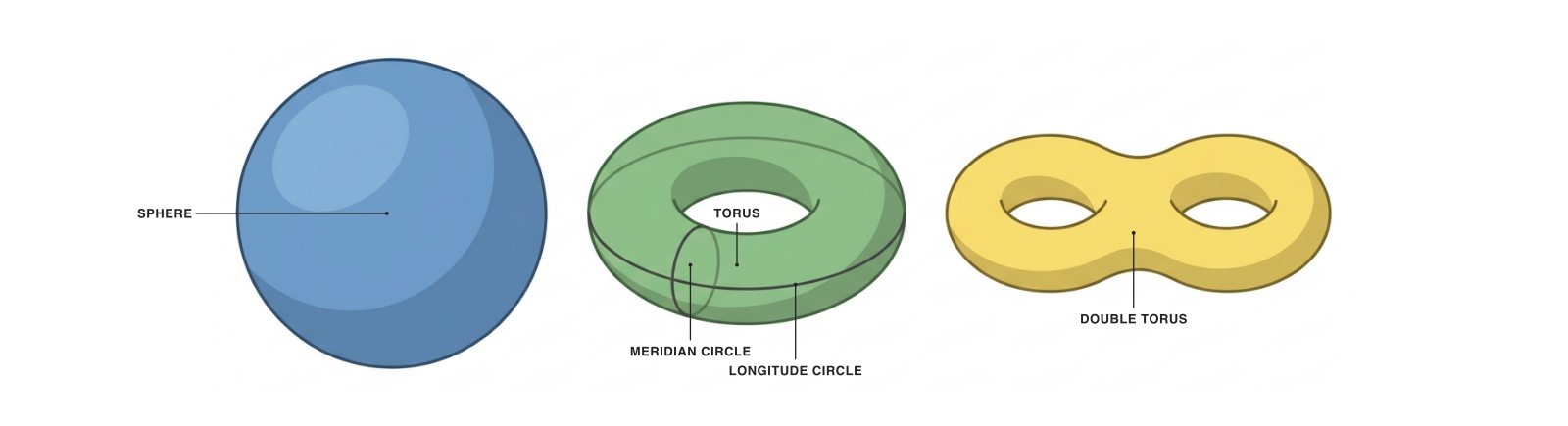
Conceptual topology figures. Use an exact construction when a result depends on coordinates, angles or incidence.
Mathematical figures range from sketches that build intuition to constructions that encode part of a proof. Decide which role your figure has before choosing an illustration or a source-based drawing.
The surface example above is useful for introducing genus and representative loops. A free body diagram or commutative diagram instead relies heavily on exact labels, arrows and relationships.
Choose between a conceptual picture and a construction
Use an illustration when the reader needs to recognize a shape or imagine a transformation. State any simplification in the caption, and keep the notation outside the artwork when separate text is easier to read.
Use vector or source-based geometry when precise relationships matter. Keeping TikZ or another inspectable source makes it easier to correct a label, preserve a construction and match the document’s typography.
Make notation consistent with the surrounding text
A figure can be internally clear and still confuse a reader if it uses different variable names from the document. Check indices, capitalization, orientation and the distinction between objects and maps.
For a commutative diagram, verify the source and target of each arrow and the intended equality of compositions. The visual appearance alone does not establish commutativity.
Prepare versions for teaching and writing
A lecture slide may benefit from a highlighted curve and a short caption. A paper may need explicit assumptions, smaller but legible labels and a format the submission system accepts.
Keep the source that represents the important structure. A rendered image is convenient for placement, but it is not always the best place to make a mathematical correction.
A prompt to start from
Frequently asked questions
References and further reading
Illustrations are explanatory models. Colors, proportions and selected structures are simplified to support the topic.
Keep exploring
Try it free
Start with a figure. Make it yours.
Open a starter, adapt the labels, and create an illustration for your next lecture or research discussion.
Starter examples are free to open. AI generation and edits use credits.