
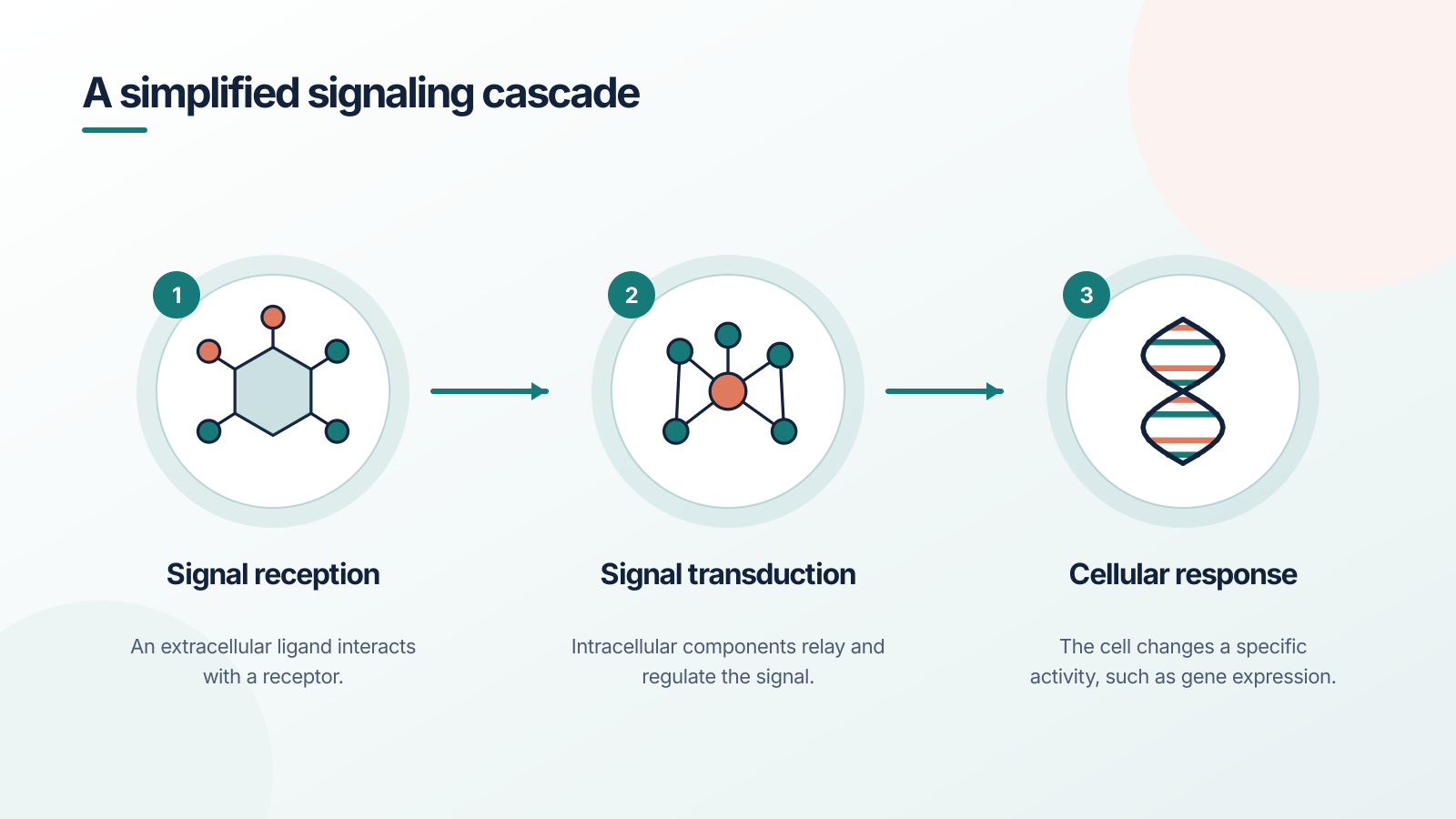
A broad conceptual model. The arrows connect stages; they do not specify individual biochemical reactions or prove causation.
A signaling diagram can describe an overview or a specific pathway. This template starts at the overview level: a signal is received, an intracellular process relays it, and the cell responds.
That structure is useful for a first explanation. A pathway-specific figure needs the actual components, cellular compartments, interactions and supporting references.
Begin with the level of detail the audience needs
For an introductory lesson, keep the reception, transduction and response headings. Identify where the receptor sits and what kind of response is being discussed.
For a specialist audience, generic boxes may be too vague. Replace them with the specific components and explain which interactions are directly established and which are part of a proposed model.
Make every arrow earn its place
An activation arrow, an inhibitory bar and a transport arrow convey different information. State the convention and use it consistently. A simple sequence arrow should not be mistaken for evidence of direct molecular binding.
Keep compartments explicit when the explanation crosses a membrane or enters the nucleus. If a component changes location, make that change readable rather than leaving the audience to infer it from color.
Check names, states and feedback
Verify molecular names and capitalization against the terminology used in your field. Distinguish a protein from a gene when that difference matters, and indicate relevant states or modifications.
Feedback loops and parallel branches can change the interpretation of a pathway. Add them because they belong to the model, not to make the diagram appear more sophisticated. Use the caption for simplifications that would otherwise mislead.
A prompt to start from
Frequently asked questions
References and further reading
Illustrations are explanatory models. Colors, proportions and selected structures are simplified to support the topic.
Keep exploring
Try it free
Start with a figure. Make it yours.
Open a starter, adapt the labels, and create an illustration for your next lecture or research discussion.
Starter examples are free to open. AI generation and edits use credits.